
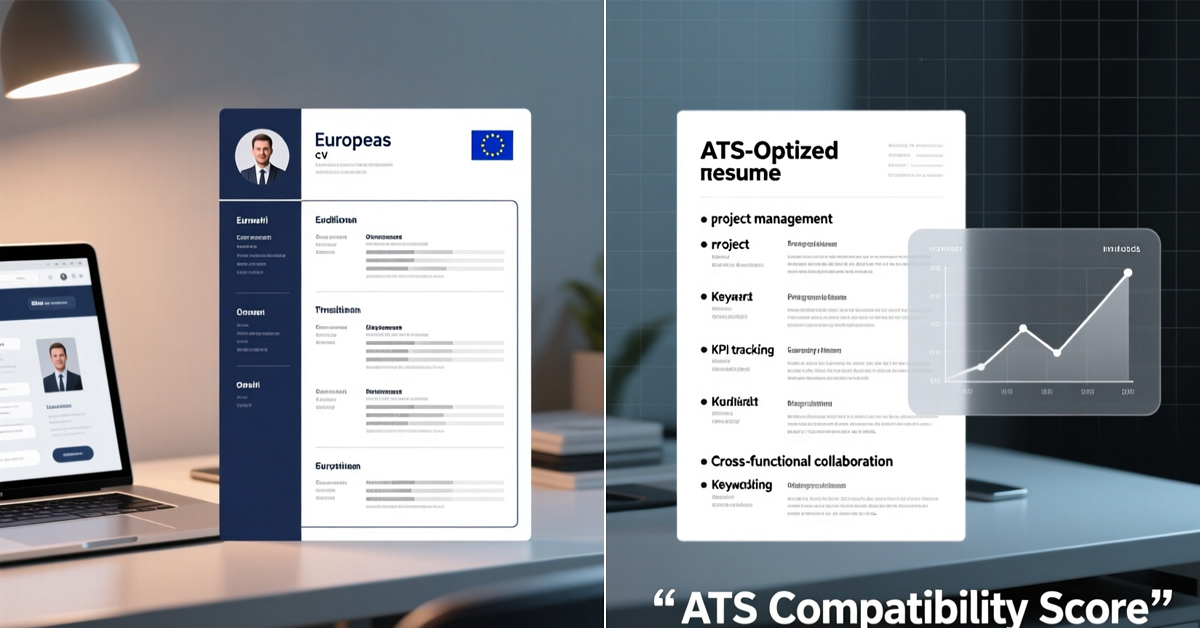
Stuck choosing between a Europass CV and an ATS-optimized resume? You’re not alone. Both aim to land you a job, but they play by completely different rules.
Let’s cut through the confusion. Understanding the core purpose of each document is the first step to using the right tool for the right job.
The Europass CV: Europe’s Standardized Format
Born from an EU initiative, the Europass CV is designed for uniformity and ease across European borders. Its structured, fill-in-the-blank approach ensures all key information is presented in a predictable way, which can be helpful for human reviewers in academia, public sectors, or international roles within Europe.
Key Features:
- Standardized Sections: Fixed headings like “Personal Information,” “Work Experience,” and “Digital Competencies.”
- Focus on Transparency: Makes qualifications and experiences easily comparable across different EU education systems.
- Built-in Tools: Often paired with the Europass cover letter builder and digital credential wallet.
The ATS-Optimized Resume: The Machine-Friendly Candidate
An ATS-Optimized Resume is built for one mission: to pass through an Applicant Tracking System (ATS). These are the software tools used by the vast majority of medium-to-large companies (globally) to scan, rank, and filter resumes before a human ever sees them.
Key Features:
- Clean, Simple Formatting: Uses standard headings (“Work Experience,” not “Employment History”), avoids columns, tables, or graphics.
- Strategic Keyword Use: Mirrors the language and specific skills from the job description.
- Quantifiable Achievements: Focuses on results (e.g., “Increased sales by 15%”) rather than just duties.
Head-to-Head: The Key Differences
| Feature | Europass CV | ATS-Optimized Resume |
|---|---|---|
| Primary Goal | Standardization & Clarity for Humans | To be parsed & ranked by Software |
| Format & Design | Structured, often with two columns | Clean, single-column, minimalist |
| Keyword Focus | General and descriptive | Highly tailored to each job posting |
| Best For | Academic, EU public sector, some international roles | Corporate jobs, private sector, North America, global companies |
| Biggest Risk | Often gets scrambled by ATS software, losing key info | Can look too plain for certain creative or human-focused reviews |
Europass CV vs. ATS Resume: Which One Should You Use?
The choice isn’t about which document is better, but which is the right key for the lock.
Use a Europass CV when:
- You are applying within the European Union’s public sector or institutions.
- The job posting explicitly requests a Europass format.
- You’re in academia or a field where a detailed, standardized list of publications and projects is essential.
Use an ATS-Optimized Resume when:
- You are applying to corporations, startups, or the private sector anywhere in the world.
- You are submitting your application via an online company portal (like Workday, Greenhouse, etc.).
- The job is in competitive fields like tech, finance, marketing, or engineering.
Smart Hybrid Strategy for the Modern Job Seeker
You don’t always have to pick just one. A strategic approach is to:
- Always have your master ATS-optimized resume ready as your base document. This is your core, adaptable tool.
- Tailor this resume for each application, sprinkling in keywords from the specific job ad.
- Create a Europass CV only when it is required. If you need one, consider also submitting your clean ATS resume alongside it if the system allows, noting it as an “alternative format.”
Pro Tip: When in doubt, a sleek, well-written ATS-friendly resume is the safer global default. You can always adapt its content into a Europass template later if a specific opportunity demands it. The reverse—trying to force a scrambled Europass CV through an ATS—rarely works.
By matching your document to the gatekeeper—be it a human administrator or a software algorithm—you dramatically increase your chances of getting to the next stage: the interview. Choose wisely, and tailor relentlessly. Your next job is out there; make sure your application gets seen.