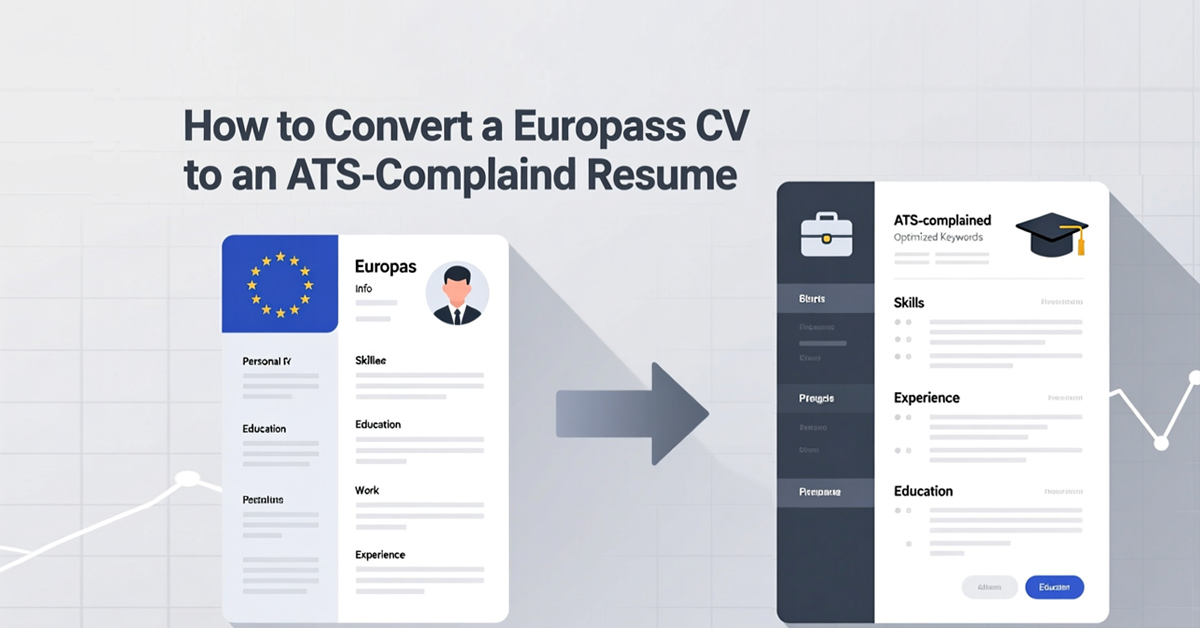
Here’s how to turn your Europass CV into an ATS-friendly resume that gets you interviews.
Your meticulously detailed Europass CV might be perfect for European academia or government roles, but it’s a common roadblock for job seekers applying through modern company portals. The reason? Most corporations, especially in North America, the UK, and increasingly worldwide, use Applicant Tracking Systems (ATS)—software designed to scan, rank, and filter resumes. The Europass format, with its complex tables, graphics, and unusual structure, is notoriously difficult for these systems to read, often causing your information to get jumbled or lost entirely. Converting it is not just a formatting change; it’s a strategic rewrite for both machine and human readers.
Why the Europass CV and ATS Clash
Think of an ATS as a robot recruiter. It scans your document for keywords, skills, and experience relevant to the job description. The Europass CV, while standardized for human eyes across Europe, uses elements that confuse this robot:
- Heavy Use of Tables: ATS software often struggles to parse information inside table cells, leading to misread data.
- Headers & Footers: Critical contact details placed in headers or footers can be completely ignored.
- Non-Standard Section Headings: Fancy titles or non-English headings might not be recognized.
- Graphics & Icons: Even the subtle Europass iconography can be seen as corrupt code.
The result? A potentially qualified candidate gets automatically rejected before a human ever sees their application.
Your Step-by-Step Conversion Guide
1. Start Fresh in a Clean Document
Open a new document in Microsoft Word or Google Docs. Do not simply try to reformat your existing Europass PDF. Copy and paste your raw text over, leaving all formatting behind. This is your clean slate.
2. Choose an ATS-Friendly Layout
Opt for a simple, single-column, reverse-chronological format. Use clear, standard section headings like:
- Professional Summary (instead of “Personal Statement”)
- Work Experience
- Education
- Skills
- Certifications
3. Optimize Your Content for Keywords
This is the most crucial step. Carefully analyze the job description you’re targeting. Identify the key hard skills (e.g., “Python,” “Project Management,” “SEO Analytics”), soft skills, and certifications listed. Naturally integrate these keywords into your Professional Summary, Work Experience bullet points, and Skills section. Avoid “keyword stuffing,” but ensure they are present.
4. Transform Your Work Experience
Europass CVs can be dense. For an ATS resume, use bullet points with powerful action verbs. Quantify achievements wherever possible.
- Instead of: “Responsibilities included managing social media accounts.”
- Write: “Grew Instagram audience by 45% (10k followers) in 6 months through a targeted content calendar and community engagement strategy.”
5. Simplify Your Contact Information
Place your name, phone number, professional email address, and LinkedIn profile URL (optional) at the very top of the page, in plain text. Remove your photo, date of birth, marital status, or other personal details not commonly included on resumes in your target country.
6. Save and Test the Final File
Always save and submit your final resume as a .docx file unless specifically asked for a PDF. The .docx format is most reliably read by ATS. Before sending, test it! Use a free ATS resume checker online (like Jobscan or Resume Worded) to see how your new format parses and to get a keyword match score against a job description.
What to Leave Behind From Your Europass CV
Some Europass standards don’t translate. You can typically omit:
- References: The phrase “References available upon request” is assumed.
- “Europass” Labels: The branding itself is not helpful for an ATS.
- Hobbies & Interests: Unless they are directly relevant to the job, they take up valuable space.
By following this process, you’re not just translating a document—you’re reframing your professional story for a new audience. You take the valuable experience from your Europass CV and present it in a format designed to pass the first, most critical test: the digital gatekeeper. This conversion is a non-negotiable step in applying to most modern companies and will dramatically increase your chances of landing in the “yes” pile.